One good practice the MBA institutes have started in last few years, is to create an induction program to welcome the young students in to the course. As part of design, they call industry leaders to share expectations with the students, which I presume would go as inputs for students to practice, during the two years of preparatory phase, before they finally join the corporate. The concept seems to be very good. This year I was fortunate to address many of these young minds in few of the institutes across India.
In some way, it was an eye opener for me. So many aspiring young people full of questions. However in every class interaction, within few moments I could see a common pattern, everyone is blindly asking for a prescription or a shortcut to a good job, and they qualified ‘good job’ as annual salary above INR 600 K, (preferably good quality work & healthy work culture). It seemed the sole purpose of joining the B’School is to get a ticket to this ‘so called’ success. Therefore, the crux of the interaction becomes how to map this path to success. In short, a prescription that tells them to choose certain electives, practice some skills, do some projects and work on personality development, and guide them so that they can qualify for some entry level roles. Out of curiosity, when inquired about immediate need of money in their lives, not a single student had any immediate family dependency on them.
That triggered a thought in my mind. Are these the type of questions the students should be asking to industry seniors. They are not even few weeks old in to the program and don’t even know what is the meaning of specialization. Many of them have not worked before in their life. Instead of re-looking at their life, purpose, strengths, objectives and possibilities that a MBA program can offers, they are just focus on a salary package. Just as corroboration, I have often being told by Professors from Engineering colleges (where usually placement happens in 7th semester) that after placement is over, the students simply stop learning and extremely casual to their curriculum’, which goes on to show the fact that most students joining a professional school are just interested in a good salary package and not on the means which could make them a strong professional. This in my view this somewhere promotes mediocracy.
Does corporate think the same way while selecting someone from the campus? Should Business school’s agenda be to create mediocre corporate managers or build finest professionals? Can this type of shallow preparation sustain the students in their job in the increasing competitive business environment?
I felt, it’s a responsibility on the part of corporate leaders to guide them properly, help them to change their focus and approach, to ensure that they prepare themselves for life through this program and not just for a good job. May be they are not aware that “corporate life is a continuous examination, where one is evaluated every moment in every task, and with changing times it is only becoming tougher”. Moreover many people who took a shortcut in campus, are measurably failing at a later point in their career. Hence, one need to help these students to build an agenda to do right things that can prepare them to be an excellent professional, and a leader for life; more so when the MBA programs are becoming so expensive.
When we speak about crafting an agenda, it has to necessarily focus on all-round development of the students. Having gone through the program myself & subsequently many years of hiring experience from campuses, I started thinking what traits in a candidate do we look for, and also what a student wants to do in life, specifically with many opportunities like, start-ups & other entrepreneurial ventures, Consulting opportunities etc,
- At the core one need to define the Purpose & objective of joining the program:
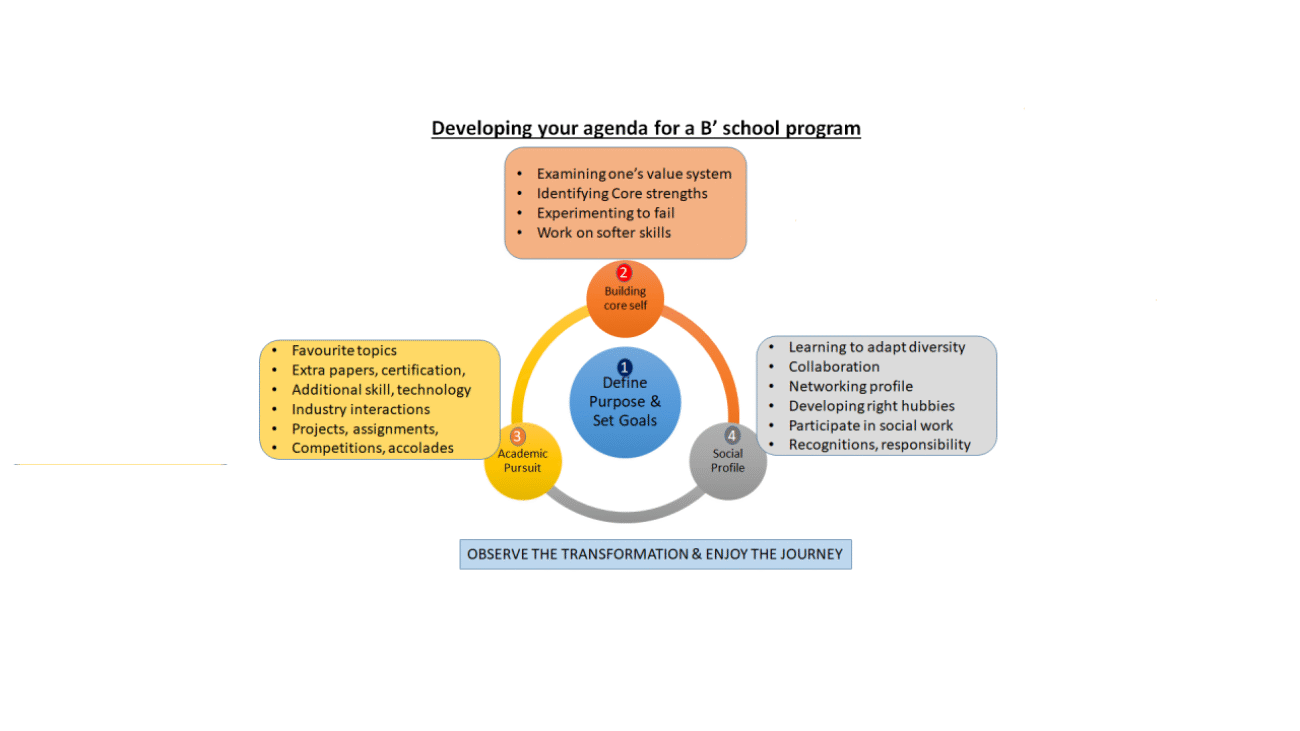
The first step has to be, Define Purpose & Set Goals – This is critical. Most often students come to Business school to spend two years of fun life and to manage a job from campus. This is a short-sighted thinking. It is important to note that, this is a place to define/refine your purpose of life, and also set certain goals that needs to be achieved at the end of two years. Check if you really want to join Corporate, or want to do your own start up, or become SME (subject matter experts) in any area, and how long you want to work. Set goals on self-development, academic achievements, building a strong social network, in a way ROI of the money invested, not just in terms of immediate campus placement, but in terms of a larger life goal.
Once we define the purpose and goals that we want to achieve from a Business school program, there are three dimensions that we need to work on, namely Building Core self, setting up Academic Pursuit, and Developing a Social profile.
2. Building Core Self:
As we define the program as a critical preparatory step for life, may it be corporate, entrepreneurial ventures, consulting, or Social works, one has to focus on his/her core self. What we are made of, our value system, our core strength. We need to examine and experiment with our values and beliefs. As a research says, we would need skills in our next generation of workforce, which don’t even exist today. Preparing for the unknown as well as building on what we are good at, are extremely important.
The other important factor to succeed in life is to ‘learn to fail’. The Business school is probably the last protected environment where students can experiment to fail. Failing means discovering our limits as well as unknown potential. As Dr Raghunath Mashelkar tweeted, FAIL (First Attempt In Learning). Other critical success factor for our life is our softer skills.
Business school is a perfect place to harness our soft and social skills to make us a good human being and a good leader. Our communication, working in teams, articulation of ideas and presentation skills, inculcating fresh thinking and inserting new ideas in our working etc.
What I would like to see for a beginner in the Business school is, to have a well-articulated development plan after taking inputs from most stakeholders and seriously work to achieve the objectives. This in my opinion is a ‘practice for life’.
3. Planned Academic pursuit:
Most often students want a prescription for cracking easy campus job, which means spending most of the time in extracurricular activities, campaigning for getting more companies onto campus, preparing for the external smartness including mugging up answers to obvious questions. In the process the students forget the basic purpose of being in the school. Lack of focus on studies, make the student extremely sallow and there is a struggle for life which is architected in the campus itself. It is a real pity. The companies who hire students, are going to do so purely on the value the students bring on to the table and the major part of the value is derived from, the fresh and ‘independent thinking’, subject matter knowledge, as well as the application of the knowledge, that the student demonstrates.
Companies do look at the intensity of various efforts / initiatives that students put in during the full 2 years at the campus. Hence, few suggestions that students can incorporate into their learning agenda can be,
– Do book readings, in areas which are of interest to them and allied to their curriculum, or read more of research papers to enhance their knowledge and critical appreciation of the developments in that area.
– Do projects with corporates, start-ups or NGOs to experience real world and building outcome driven learning, including a major one (summers) as part of their curriculum
– Practical experience through internship, which may involve many short stints
– Choose multiple specializations or allied Diploma or Certifications
– Participate in competitions and work towards winning accolades and awards in your academic pursuits, including inter university case studies, scholarships, positions in class, Paper presentations etc
4. Build a strong social profile:
One of the critical agenda in a Business school tenure should be to weave one’s social skills. This is becoming increasing critical for the new generation of leaders. Companies look for competencies like, social influence, ability to build and propagate opinions & views, ability to lead and deliver on social initiatives etc, This mostly gets assessed by one’s quality of social interactions, involvements, collaborative efforts, presence on social media, followership etc. Even through Artificial Intelligence, ones social profiling can be done and evaluated as part of hiring process. Hence, students must look at developing and enhancing their profiles systematically. Some recommended activities they can think of,
– Build social diversity and your comfort level in hostel, campus, other groups, including learning different cultures, values, language, social norms etc
– Please create appropriate profile, interact on right social issues, create followership as part of social change process, through Linked-in, FB, Twitter etc
– Get connected to influential people and participate in social discussions, be part of social groups who raise social issues
– Be part of collage groups, student associations, community development etc.
Observe the transformation:
It is important to observe and monitor the changes one is going through the whole program, through time to time feedback, our own response to events, challenges, our grades and accolades from others. Extremely important is to build an ecosystem with professors, staff, friends, seniors in industry for learning and feedback on positive developments.
Enjoy the journey:
One should not forget the fact that, this is the last phase of student life in a designated campus, hence life has to be enjoyed, experimented, and gather lot of fun and good memories. Having suggested to focus on the above four areas, again is not prescriptive. These are to be designed on individual capabilities, resources and interest. However, it is important to take a holistic view of life, one’s purpose, milestones, and enjoy the whole process of growth and development.
In conclusion, it is only fair for students to look at a B’School as a stair to the first lucrative job. However I strongly recommend to read “How will you measure your life”, by Clayton M. Christensen, where he describes how to fall prey to extrinsic motivators and read the priorities of life as defined by existing circumstances, which would change in no time. Hence, balancing the larger purpose of life with emergent opportunities and building capabilities to execute it seamlessly will define our success.